
Systems do not talk to each other
CRM, ERP, finance, operations, service, and reporting tools create competing versions of the truth.
For CEOs, COOs, CFOs, owners, presidents, and PE operating partners
George Huene and the Able.Digital team help mid-market companies bring order to disconnected systems, unreliable reporting, AI pressure, cybersecurity risk, and vendor sprawl without hiring a full-time CTO or CIO before the business is ready.
Best fit: $20M-$300M revenue · 100-1,500 employees · founder-led, family-owned, or PE-backed operating companies

The common leadership gap
Most mid-market companies do not fail because nobody is working hard. They struggle because no senior business-facing leader owns the roadmap across systems, vendors, reporting, risk, AI, and execution.
Talk through your current friction →CRM, ERP, finance, operations, service, and reporting tools create competing versions of the truth.
The team handles tickets and projects, but leadership still lacks prioritization, visibility, and decision support.
Spend keeps growing while architecture, accountability, and ROI remain unclear.
Ownership wants action, but you need practical use cases, guardrails, data readiness, and a sane sequence.
What leadership gets quickly
The goal is to create executive clarity fast: what is broken, what matters most, who owns it, what should stop, and what should happen next.
Interview leadership and review systems, vendors, reporting, risks, active projects, and ownership gaps.
Outcome: clear risk visibility.Identify priority gaps, duplicate spend, reporting problems, project bottlenecks, and decision friction.
Outcome: leadership sees where technology is helping, hurting, or drifting.Create the roadmap with owners, sequence, budget logic, governance, and next-step recommendations.
Outcome: a plan the CEO, COO, CFO, IT team, and vendors can execute.Book directly with George
Use this call to talk through the technology friction creating the most business risk right now: reporting, ERP, CRM, AI, cybersecurity, vendor sprawl, operational complexity, or lack of executive ownership.
No obligation. No generic pitch. If there is not a fit, George will tell you directly.
Who this helps
The same systems issue can look like a growth problem to the CEO, an execution problem to the COO, a spend problem to the CFO, and a value-creation problem to the board.
We are making bigger technology decisions, but I do not have one senior owner.
Creates: executive roadmap and decision cadence.Our systems, teams, and vendors are slowing operations down.
Creates: better process visibility and clearer execution priorities.Technology spend is rising, but I cannot clearly see ROI, risk, or accountability.
Creates: better spend discipline and budget sequencing.This company needs technology maturity without waiting a year to recruit a CIO.
Creates: a practical value-creation roadmap.Leadership wants strategy, but my team is overloaded.
Creates: executive air cover and fewer conflicting demands.Best-fit companies
George is a strong fit when the company is large enough for technology to affect margin, speed, risk, and growth but not yet structured enough to justify or recruit a full-time CTO/CIO.
$20M-$300M in revenue, typically 100-1,500 employees, often founder-led, family-owned, or PE-backed.
Multiple locations, legacy systems, manual reporting, vendor sprawl, operational complexity, or post-acquisition integration.
CEO, President, Owner, COO, CFO, PE operating partner, board member, or senior operator accountable for growth.
ERP/CRM initiative, AI pressure, cybersecurity concern, reporting failure, acquisition, vendor dispute, stalled modernization, or margin pressure.

What George does
This is not generic IT help. It is senior operating judgment applied to technology decisions that affect revenue, margin, risk, speed, visibility, and execution.
Prioritize what to fix, what to defer, what to stop, who owns it, and what the next 90 days should accomplish.
Turn fragmented systems and manual workarounds into a more coherent operating model leadership can trust.
Identify high-value use cases, data requirements, risks, and governance before spending money on disconnected experiments.
Strengthen ownership, access, vendor discipline, and executive visibility before a preventable issue becomes a crisis.
Reduce sprawl, clarify accountability, and give leadership one senior owner across vendors, systems, and outcomes.
Bring structure to integration, modernization, KPI visibility, and operational scaling when complexity rises quickly.
What this is and is not
George does not replace valuable IT teams, MSPs, software partners, or vendors. He helps leadership decide what should happen, why it matters, who owns it, and how it should be sequenced.
| Option | What they usually do | Where George fits |
|---|---|---|
| MSP | Handles infrastructure, devices, support tickets, and day-to-day IT operations. | Helps executives decide what technology should do for the business. |
| IT consultant | Solves a defined technical problem or project. | Owns the cross-functional roadmap across leadership, IT, vendors, systems, and operations. |
| Software agency | Builds applications or integrations. | Helps determine what should be built, bought, fixed, stopped, or sequenced. |
| AI advisor | Often focuses on tools, pilots, or broad AI strategy. | Prioritizes AI use cases based on workflow, data readiness, ROI, governance, and risk. |
| Full-time CTO/CIO | Senior executive hire with ongoing salary, benefits, and recruiting risk. | Provides senior judgment fractionally until the business is ready for a permanent executive. |
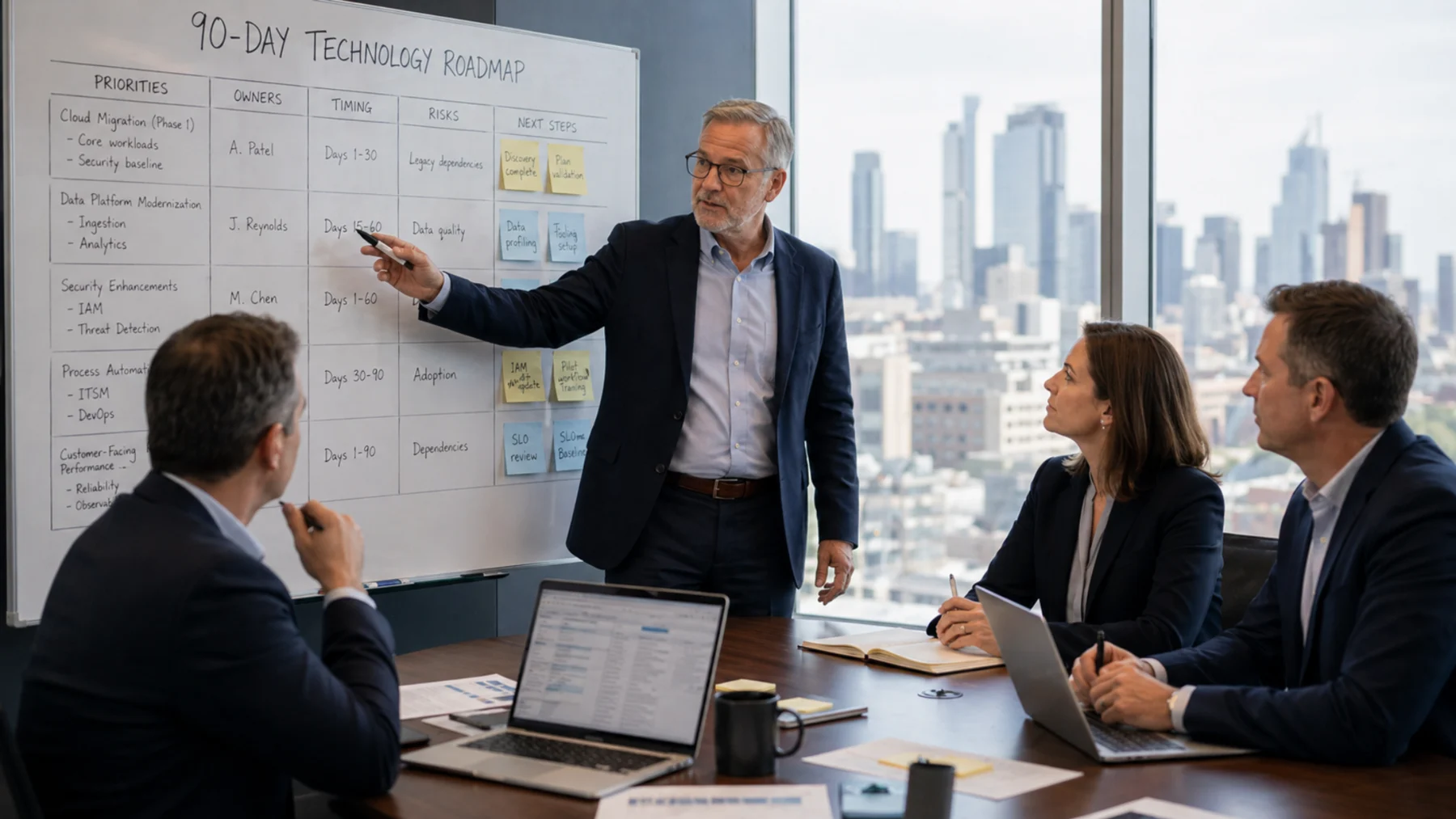
Technology Leadership Assessment
The assessment gives leadership a practical picture of where the business is exposed, where momentum is being lost, and what the next 90 days should look like. It is designed for leadership teams that need a decision document, not a generic technology audit.
Works with your current team
George gives leadership a senior technology owner across business priorities, vendors, systems, data, risk, and execution. In most engagements, the internal IT team remains essential. The difference is that they get clearer priorities, better executive alignment, and fewer conflicting demands.

Representative outcome snapshots
Use approved client metrics or named references when available. Until then, these snapshots show the situations this service is designed to address.
Clarifies: which systems own which data, where manual workarounds exist, and what reporting leadership can trust.
Value: better decisions and less time debating numbers.Clarifies: which vendors are strategic, duplicative, underperforming, or missing ownership.
Value: lower waste and clearer accountability.Clarifies: which use cases are worth pursuing, what data is required, and what governance is needed.
Value: practical AI roadmap without distraction.Clarifies: why the project is stuck, who owns decisions, and what sequence gets progress moving.
Value: faster execution and reduced project risk.Clarifies: which systems, data, and security issues could slow integration or value creation.
Value: cleaner operating visibility and faster post-close alignment.Fastest way to decide
Bring the issue creating the most friction: reporting, ERP, CRM, vendors, cybersecurity, AI, operations, or lack of ownership. You will leave with sharper clarity even if you never hire us.
Why George
George is positioned for companies that need more than infrastructure management and more than advice. The value is in translating business goals into a technology roadmap that leadership, operations, finance, IT, and vendors can actually execute.
Focused on growth, productivity, reporting, governance, and decision quality.
Useful when customer lifecycle, service operations, reporting, and executive dashboards all matter at once.
Bridges strategy, systems, vendors, and execution without losing the business context.

FAQ
If technology is affecting growth, reporting, operations, AI decisions, cybersecurity, customer experience, or vendor spend and no one at the executive level fully owns the roadmap, you are likely in the right zone.
MSPs and IT teams are often valuable, but they usually do not own executive prioritization across finance, operations, systems, vendors, risk, and business outcomes. This work is senior technology leadership and governance.
Usually no. A good Fractional CTO/CIO should make the internal team more effective by clarifying priorities, improving executive communication, and reducing conflicting demands.
Most companies should start with the Technology Leadership Assessment. It creates a practical, low-risk way to define priorities before committing to ongoing support.
Tiny companies looking only for low-cost IT execution, startups needing a product-only CTO, and businesses that already have a strong full-time CTO/CIO with clear authority are usually not the best fit.
Prefer to send context first?
Use this form if you want to ask about the Technology Leadership Assessment, share context before booking, or request a follow-up from George.
Email: cto@able.digital
Phone: +1 (312) 625-8490
Address: 680 N Lake Shore Dr Ste 110, Chicago IL 60611